Selling testing to management rarely works with arguments about code quality. Nobody in the boardroom loses sleep over coverage percentages or elegant test architecture.
It works with speed, reliability and a concrete cost figure. Three ways to make that translation.
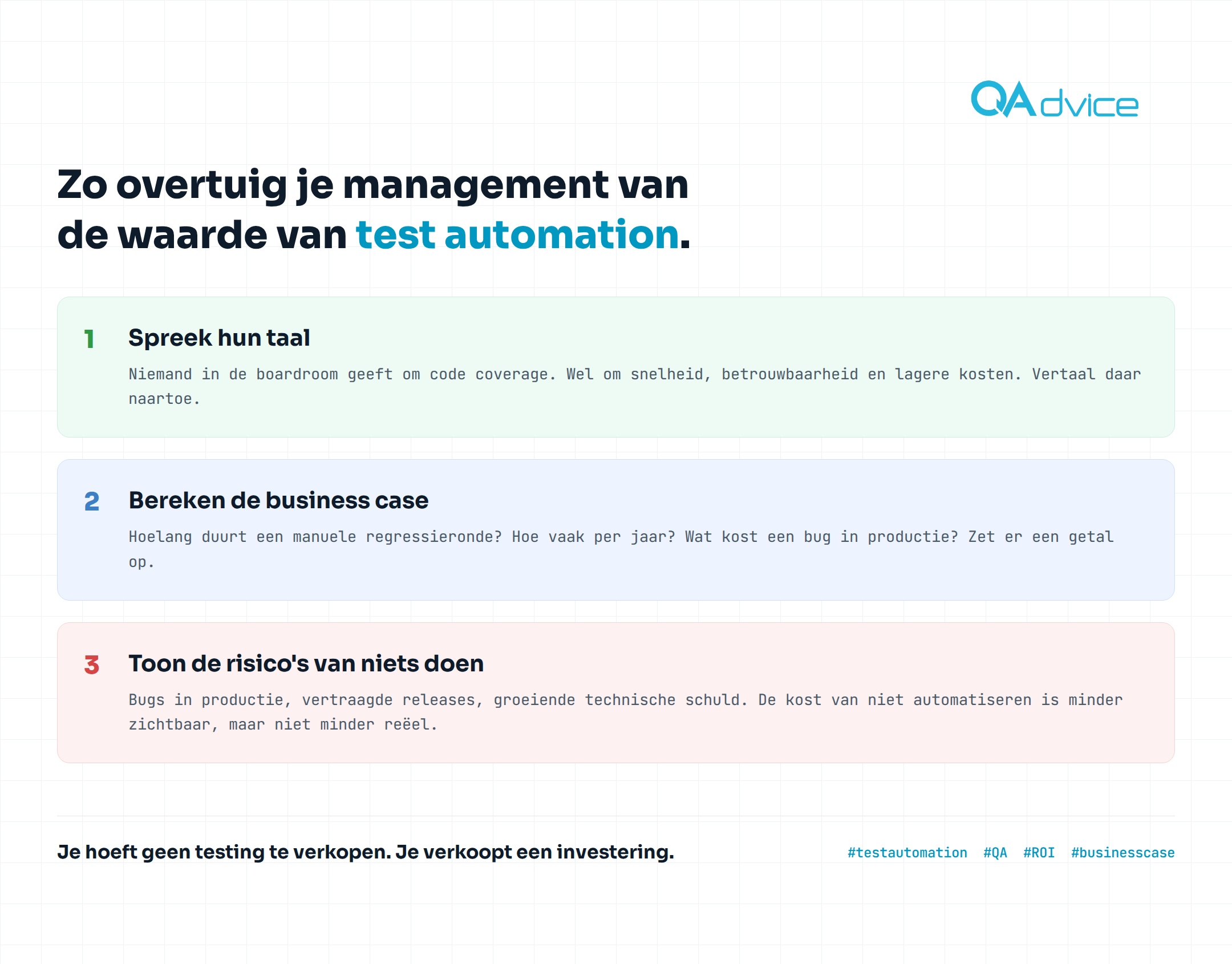
1. Speak their language
Nobody in the boardroom cares about code coverage. They care about speed, reliability and lower costs. Translate toward that: a test suite that gives confidence is a team that can release faster. Less time spent on manual regression is more time for features customers actually see.
2. Calculate the business case
How long does a manual regression round take? How often does that happen per year? What does a bug that reaches production cost? Put a number on it. A concrete figure convinces where a principle doesn't.
3. Show the risks of doing nothing
Bugs in production, delayed releases, growing technical debt. The cost of not automating is less visible than the cost of automating, but no less real. Make that difference explicit: what does it cost the team today to keep doing what it's always done?
How to make it concrete
The formula is the same as for any investment decision: cost versus benefit, expressed in time and money, not in technical terms. Want to calculate that figure yourself for a specific test or test set? The break-even formula we work through in another article is a good starting point.
So selling testing isn't a matter of persuasion, it's a matter of translation. Don't say you want to write tests. Say how much time the team currently loses to manual work, what that costs, and what changes once that goes away. You don't win that conversation with arguments. You win it with numbers.
Sounds familiar?
We'll review your test approach and tell you honestly where the gains are. And where they aren't.
Book a call